


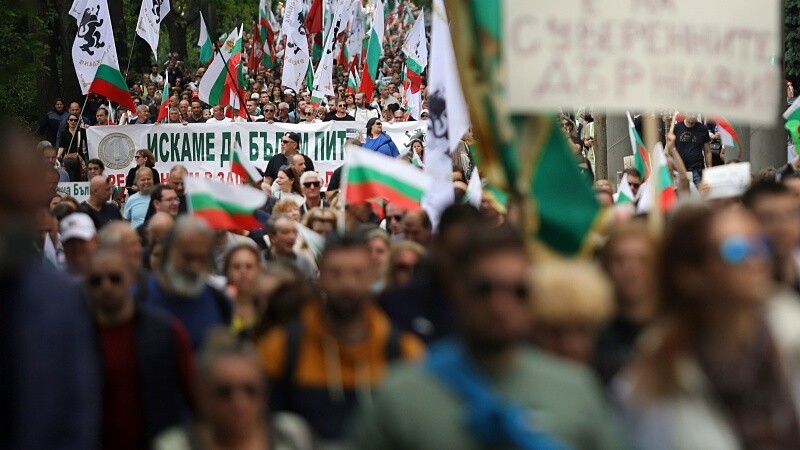
Massive protests in Sofia and other Bulgarian cities against the plans of the ruling coalition forced the government to back down on a bill that would increase contributions to individual pensions and social programs. The government should have discarded the budget project the morning after the protests. All of Eastern Europe is on the front line of the war. Warsaw's goal is to use this lever to facilitate the extraction of Ukrainian wealth through that vast territory, and at the same time, lead the costly plan of 'containment' of Russia, disregarding and opposing France and Germany. Beneath this integration, a fierce battle is being waged for the spoils of Ukraine between France, Germany, and Poland. The government rests on a fragile and extremely divergent alliance that brings together the pro-European center-right, the pro-Russian Bulgarian Socialist Party, and another nationalist-leaning formation. It projected a 3% deficit and a minimum wage of 620 euros per month. The latter drives the so-called 'Three Seas Initiative,' which connects the territories between the Baltic, the Adriatic, and the Black Sea, where Bulgaria plays a key role. The potential entry into the common zone has caused fears among the population of this Balkan country of a sharp rise in prices. It is the poorest country in the European Union and the second in terms of corruption, second only to Hungary. Bulgaria joined the Schengen area this year, a European free movement zone without internal border checks between member countries, which with the rearmament of Europe has its military complement: a 'military Schengen,' whose objective is to facilitate the free movement of troops and equipment throughout the bloc heading east, as contingency planning against Russia. Unusually, the protests were not limited to Sofia. Several factors seem to have contributed, with many expressing anger over Bulgaria's decision to adopt the euro on January 1, although this is yet to be seen: 'The next few months are extremely important for the political direction of Bulgaria,' the prime minister has stated, warning that 'the adoption of the euro is not guaranteed,' reports the Bulgarian newspaper Telegraph. Multitudes gathered in numerous towns and cities across Bulgaria. Bulgarians have gone to the polls seven times since 2021 to elect a Parliament that has been paralyzed by a string of coalitions led by different center-right and right-wing parties. 'The magnitude of the December 1st demonstrations surprised everyone.' Moscow has already described this supposedly 'economic' initiative as a series of hostile military and logistics projects to its interests. The country's president, the pro-Russian Rumen Radev, advocated during the protests for the resignation of the government and the holding of new elections. The demonstrations were called by opposition parties that do not have broad public support: 'the budget project included tax and pension increases and greater borrowing to finance public spending'. Real power lies with the head of government, Prime Minister Rosen Zhelyazkov, a member of the Citizens for European Development of Bulgaria (GERB) party, who took office on January 16, 2025. This Frankenstein coalition is the latest experiment aimed at putting the country on the right track after a prolonged period of political instability.